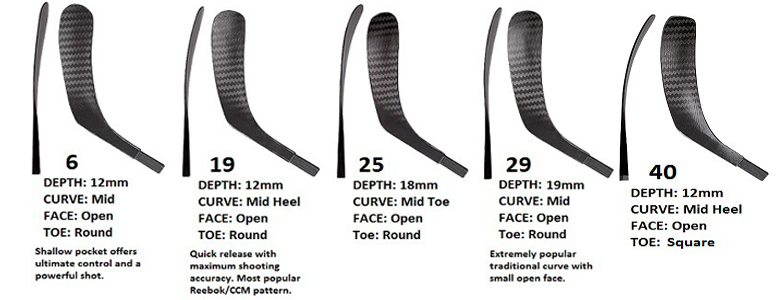
Blade models
When buying a new ice hockey stick, there are several different factors you can take into account. For example, height, weight and flexibility, but maybe it's the bend on the blade of your ice hockey stick that is what you look at the most. Most brands of ice hockey sticks have a variety of blades to choose from, with different strengths and weaknesses depending on personal preference.
When choosing which curve would be best for you, it's important to consider the position you're playing, the type of shot you're taking in the first place, and what other traits enhance your game. With the help of our blade guide, we hope to help you in your choice of blade.
What influences my choice of blade?
Heelcurve are blades that have more of a bend near the base (or heel) of the blade. This means that the bend of the blade begins here with the middle and toe of the blade being straightened a little. Heel curves are primarily used by defenders because they help improve the power and accuracy of slap shots and stable passes.
On the contrary, toecurve are leaves that have most of their bend at the toe area of the leaf.
Toecurve is often preferred by forwards because they allow them to lift the puck faster and easier during shooting in tight spaces.
Midcurve is a mix of these two profiles. Due to the fact that most of the bend is in the center of the blade, ice hockey sticks with these blade profiles are excellent for puck handlers, passers, and precision on all types of shots, including backhand shots.All leaf models have a certain degree of loft, which can be likened to how golf wedges look, but to a much lesser extent.
Blade models with a closed profile will help keep shoots low and powerful, with more straight line speed. Slightly open profiles are slightly more open than the closed option, so it will still provide great power on heavy shots, while also giving players easier to lift the puck when shooting.
Open leaf types are, as the name says, the most open of the three. Blade patterns with open spaces are great for getting the puck up in the air as quickly as possible in tight areas.
Large or small bend refers to how deep the actual bend of the blade is. For perspective, a completely flat blade has a zero depth. A small bend gives great accuracy on all shots and puck control but becomes more difficult to lift the puck with.
The most common Lie on standard clubs ranges from 4.5 to 6. A lie 4 is great for players who skate with a lower center of balance, with the puck in front of them more often. A higher scythe, like six, will cater to players skating more upright, with the puck closer to the body. This will be the recommended mode for quick puck handling forward, and is the most commonly found on standard sticks. A scythe 5 is a good balance between the two.
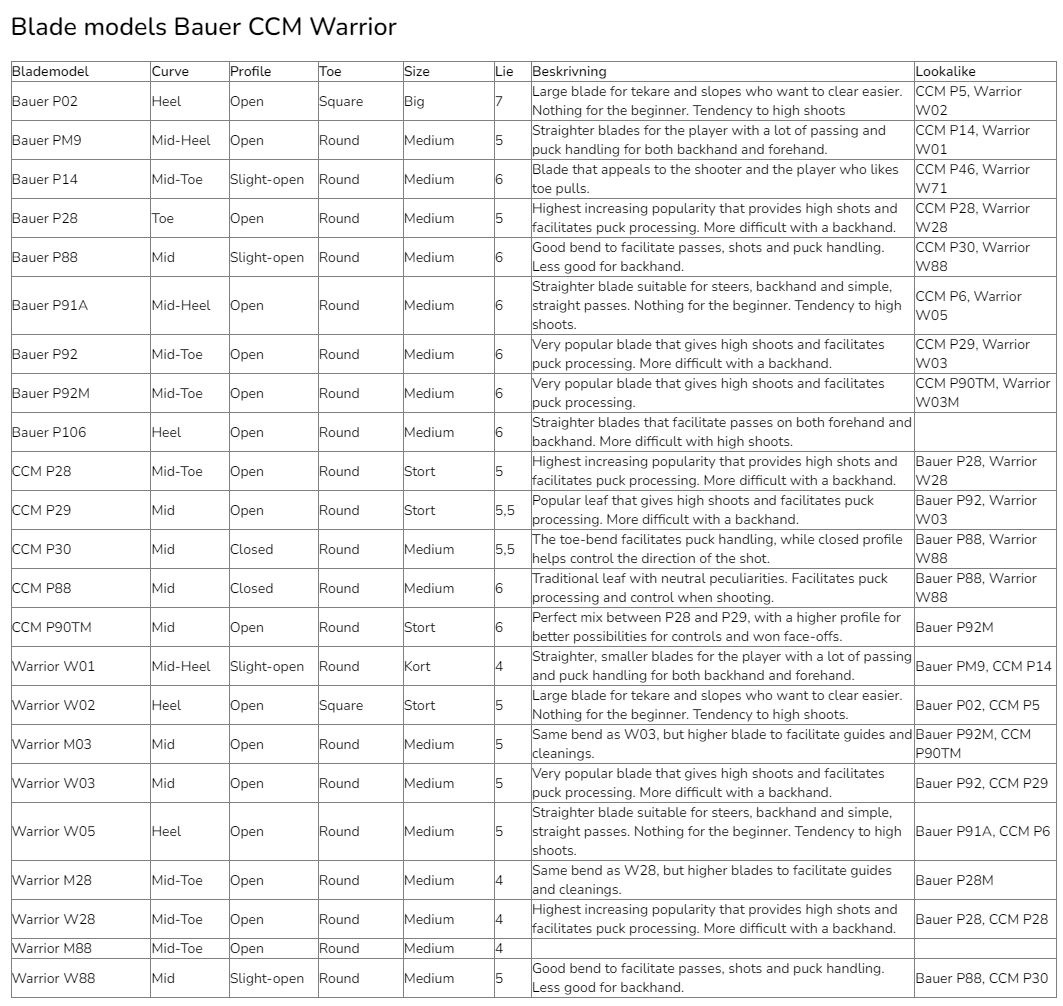
CCM