
Guide - Starting to play hockey - what you need!
- Secure payment by card
- E-mail us, we reply swiftly!
Description
Tips for hockey parents
Skating shoes
Skating can be difficult at first, but kids tend to develop balance and agility quickly. Ice hockey skates can feel a bit stiff when you squeeze them, but with the padded interior and flexibility in the right places in the shell, it will work great.
Children's feet look very different and therefore there are different models of skates offered by the different suppliers on the market. There are skates in different types of lasts, previously the most common were D and EE, where D is the "normal" width and EE a wider version. Now the suppliers have developed three different ones to suit everyone. The skates are available in several different price ranges and at the beginning of the hockey career you do not need to invest in the very worst. So far, some details do not make that benefit, but the most important thing is that the skate sits well on the foot and is adapted to the player's ability and weight.
We scan and measure our customers' feet to get recommended models, then we ask questions to find out what level the player is at. Everything to find the right model that is adapted to the player's foot and level.
If it's the first time, and the child wants to try playing hockey - see if you can borrow skates from a friend. Remember, they need to be the right size and check if the rail needs sharpening. Often clubs will also lend them out to try our fun sport!
Skate guards- It's important to protect the steel of your skates, so don't forget to buy a pair of skate guards to use when there's no rubber mat to walk on off the ice.
Helmet
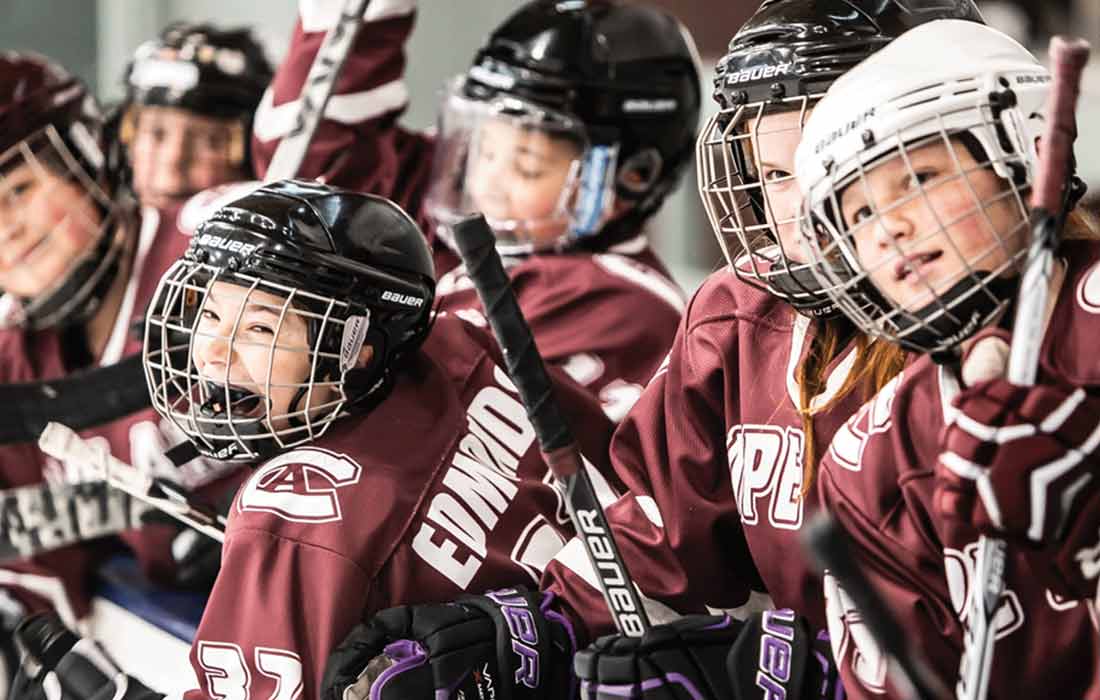
A helmet is an important protection for the head, brain, eyes and teeth. It is mandatory to wear a CE-approved helmet both during matches and training, regardless of age or level. All our helmets in the shop are of course approved.
The hockey helmet should sit firmly on the head and be adjusted so that it does not slip when the child moves his or her head. The helmet should sit completely still when the child shakes their head. The back of the helmet should go down to where the head meets the neck. Getting 1 or 2 fingers between the child's eyebrows and the helmet is usually proof that the helmet is the right size.
Helmets are available in sizes XS-XL (depending on the model) and it is not possible to relate to age, height or weight when it comes to head size, get help from our staff in the store and we will help you get it right.
Keep in mind that...
- Children must have grids on the helmet, it is important that the chin is placed in the chin cup. We try out the right size of the grid, it is available in sizes XS-L.
- The edge of the helmet should be about one to two centimeters above the child's eyebrows.
- Adjust the strap under the chin so that it cannot pass over the chin. A finger's width between the chin and the strap is usually sufficient.
Undergarments
An undergarment is needed under protective equipment to avoid chafing and itching. There are two-piece undergarments with a shirt and trousers, or shorts and a t-shirt. Some also have built-in jockstraps and neck protectors, which are very handy and ensure that you never forget these important protections. 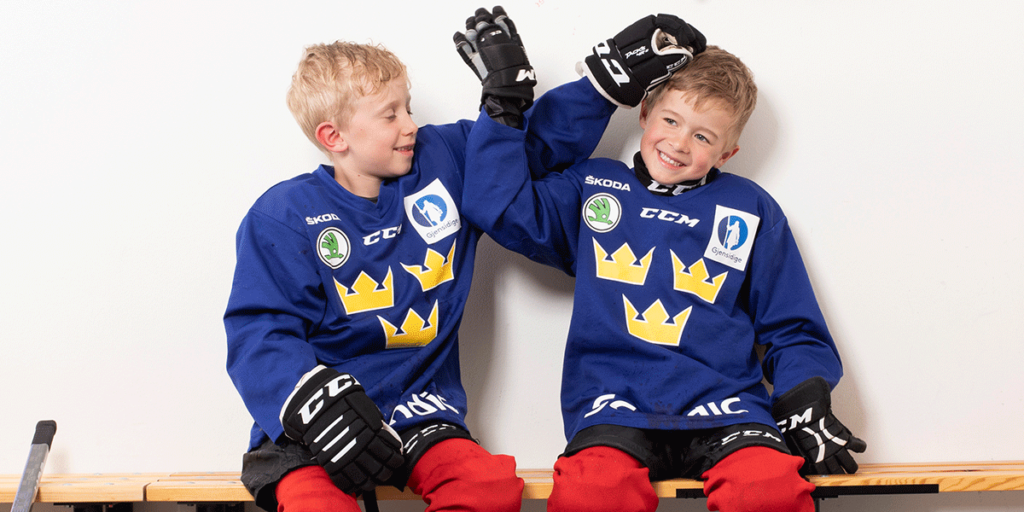
Club
For the youngest players, it's important to have a club that is adapted to their height, hand size and arm strength.
1. How long a club should you have?
- Place the child standing with their skates on, in front of the stick.
- The stick should not extend beyond the child's chin.
- Choose a slightly shorter stick if you are unsure. It is also important to choose the right "flex" of the stick, i.e. the stiffness of the stick.
2. Which hand do you use?
- Clubs are available for both right-handed and left-handed players.
3. What flex - stiffness of the club - do you need?
- Youth (30 - 42 flex)
This size is suitable for children up to 6-7 years old and beginners up to about 130 cm tall. These clubs have smaller blades and narrower shafts to give the smallest players a better grip. - Junior (40 - 52 flex)
Junior clubs are suitable for players aged 8-12 and for those who are 130 - 160 cm tall. The blade is adjusted to the correct size and the shaft is slightly narrower to suit the player's hand size. - Intermediate (55 - 75 flex)
As an intermediate player you are considered in the range of 12 - 16 years old and with a height between 155 - 175 cm. The blade and shaft are full-sized on these models, but the shaft itself is usually a little shorter than the senior clubs.
- Youth (30 - 42 flex)
Neck protectors
Neck guards protect the neck and reduce the risk of serious injury in the event of an accident. There are different models, both loose and attached to the undergarment. There are also two or three sizes, so start with the smallest one and try it out. It is important that the protection is close to the neck and not hanging or folded down, then it does not provide any protection.
Leg protectors
Make sure your knees are protected. Often these are the ones the child lands on when they fall. Remember to buy the right size. Don't be tempted to buy a bigger size to grow into, too big protectors make skating more difficult and the sport less fun. The bottom edge of the shin guard should meet the end of the skate and extend over the leg.
Gaiters - Hockey players wear special gaiters that cover the shin guards and go over the knees. If the undergarment has Velcro on the thighs, there are gaiters with Velcro, otherwise a gaiters holder is also needed to keep the gaiters in place.
Elbow protection
In addition to protecting the elbow, you also get protection on the upper forearm. Elbow protectors are available with both hard and soft padding. On the inside of the protector, it is clearly marked where the elbow should be placed and which one is for the right and left arm.
Shoulder protectors
A shoulder guard consists of four different parts: shoulder holder, chest plate, back plate and biceps guard. The chest and back plate should go so far down that they meet the hockey pants. The guard should fit tightly around the arms and chest so that the equipment does not move during practice or play.
Hockey pants
The pants have reinforced protective panels at the back, front of the legs and around the hips. The pants should go slightly below the knees but not too far. The front of the trousers is laced so that the trousers sit comfortably on the hips.
Suspenders - sometimes you may need a pair of suspenders to keep the pants from falling down on your hips, talk to the staff in the store and they can help you try them out.
Hockey socks
There are special hockey socks adapted for hockey. They are available with long shafts that go over the calf or shorter, there are also with Kevlar material that cannot be cut through. In the beginning, you can use a regular functional sock and feel your way around. It is important to choose the right size so that the sock fits tightly and is pulled up so that there are no creases in the skates, then the foot can go numb after a while on the ice.
Water bottle
In conclusion...
Ice hockey is a high-intensity sport and it is important that players stay hydrated before, during and after practice. It may feel a little cold at the beginning of the game in some rinks, but after just a few minutes of practice, players will be warm and sweaty.
And hey, you don't have to buy a whole new set of equipment. Kids grow out of their equipment before it wears out, so a tip is to talk to your friends in the club - maybe they've outgrown their hockey gear? Just make sure the pads are no more than 1-2 seasons old and that they are intact. All pads (except helmet and skates) can be washed in the washing machine, follow the instructions on the pads.
Good luck with your new hockey life and welcome to the wonderful world of the ice hockey family!