
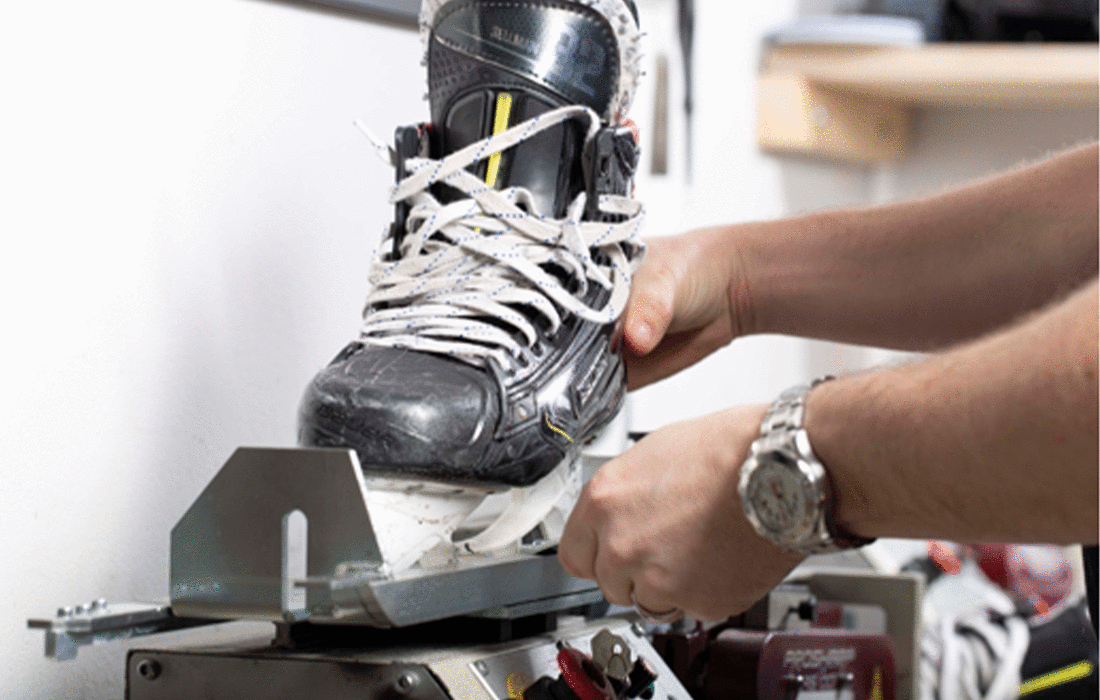
Guide - how to sharpen your hockey skates
- Secure payment by card
- E-mail us, we reply swiftly!
Description
Guide - how to sharpen your hockey skates
Sharpening of skates
What determines the sharpness of a rail is the depth of the bowl (expressed in millimeters). The deeper the bowl, the sharper it will be. The most common cup depth for an outfielder is 20-22 mm. Goalkeepers often use deeper bowls, but this should be avoided as it can cause injury problems in the knees and groin. Recommendations say 12-16 mm.
A general recommendation for choosing bowl depth is to use the formula body weight/3.14 (Pi). Example: 80 kg/3.14=25.47, round off to 25. Then you have a bowl depth (25 mm) to start from.
The advantage of a deep bowl is that you get a better grip on the turns and you can stop faster. The disadvantage is that the glide is impaired. In general, a light player can have a deeper bowl and a heavy one a little less deep. Bandy players run completely flat grinding which gives the best glide.
Profile grinding (radius versus surface area)
A profile is the rail seen from the side (or in profile). Prosharp Profiling® has been in development since the first machine came onto the market (1986) and is intended to maximize and help players reach their full potential. Prosharp Profiling® focuses on four areas: acceleration, mobility, speed and stability. By choosing the right profile for the skater, the skater can maximize or be helped in these areas. Our philosophy is that with the right profile, the skater can go up in bowl (flatter bowl) and thus avoid wear and tear on hips, groins and knees while having more power left at the end of the game. What is the right profile for a player is very individual and it all boils down to the feeling on the ice.
Profile radii are given in feet (most common) or in meters.
There are many profiles to choose from. It is not possible to say what fits a specific player but it is something you have to test to see what fits best. We can provide tips and advice but it is always up to each player to feel what suits him/her best.
Radius:
Today it is by far the most common with radius grinding. This means that there is no flat surface under the rail. You always have the same amount of steel in the ice regardless of whether you are standing in the middle or leaning forward or backward while skating. The radius is given in meters or feet, where the value is the radius of a circle.
We recommend that beginners get as much ice contact as possible. This is to give stability to their skating. Good beginner profiles are the 17 ft. and 19 ft. single profiles.
The next step is to reduce ice contact to add more acceleration and mobility to the skate. Depending on personal preference, you can test at anything from 10 ft. to 15 ft.
After that, you should start testing combination profiles, such as having one radius from center to front and another from center to back.
The latest in Prosharp Profiling® is three-radius and four-radius profiles. We call these combinations Zuperior (three radii) and Quad (four radii).
We recommend the Zuperior to outside forwards and defenders because it provides maximum glide with high speed straight ahead while providing very good balance and stability to fight down opponents in duels. We recommend Quad to centers and offensive defenders because it gives the skater excellent opportunities to change direction and perform quick transitions along with maximum mobility at high speed.

Skating surface:
In the past, the skating surface was the most common. A riding surface means that you have a completely flat surface in the middle of the rail. It is usually 4, 5 or 6 cm long. It can also be shifted 0.5-1 cm forward or backward. Example: 30-60 is a 6 cm long surface in the middle. 40-60 is a 6 cm long surface displaced 1 cm forward.
You should re-sand the profile 1-2 times per season depending on how often you sand and which sander you use. Manual sanders remove the profile after only a few sandings. If you use the automatic sanders from Prosharp, you will keep the profile longer.
Changing the rail
We can change the steel on all the brands we sell that have interchangeable steel. We stock the most common models and sizes. We recommend having a couple of extra rails that are sharpened and ready in case of an accident. If the rail breaks, for example, it is easy to change and continue playing.
Things to consider
Remember to always use skate protection in the locker room and to/from the ice. Make sure that the protectors are whole and clean. Rinse them under running water when they are dirty. Use soft pads when the skates are stored in the bag. Never put on regular skate protectors after you have dried the rail because they are already damp. The soft covers, on the other hand, absorb any moisture that remains on the rail.